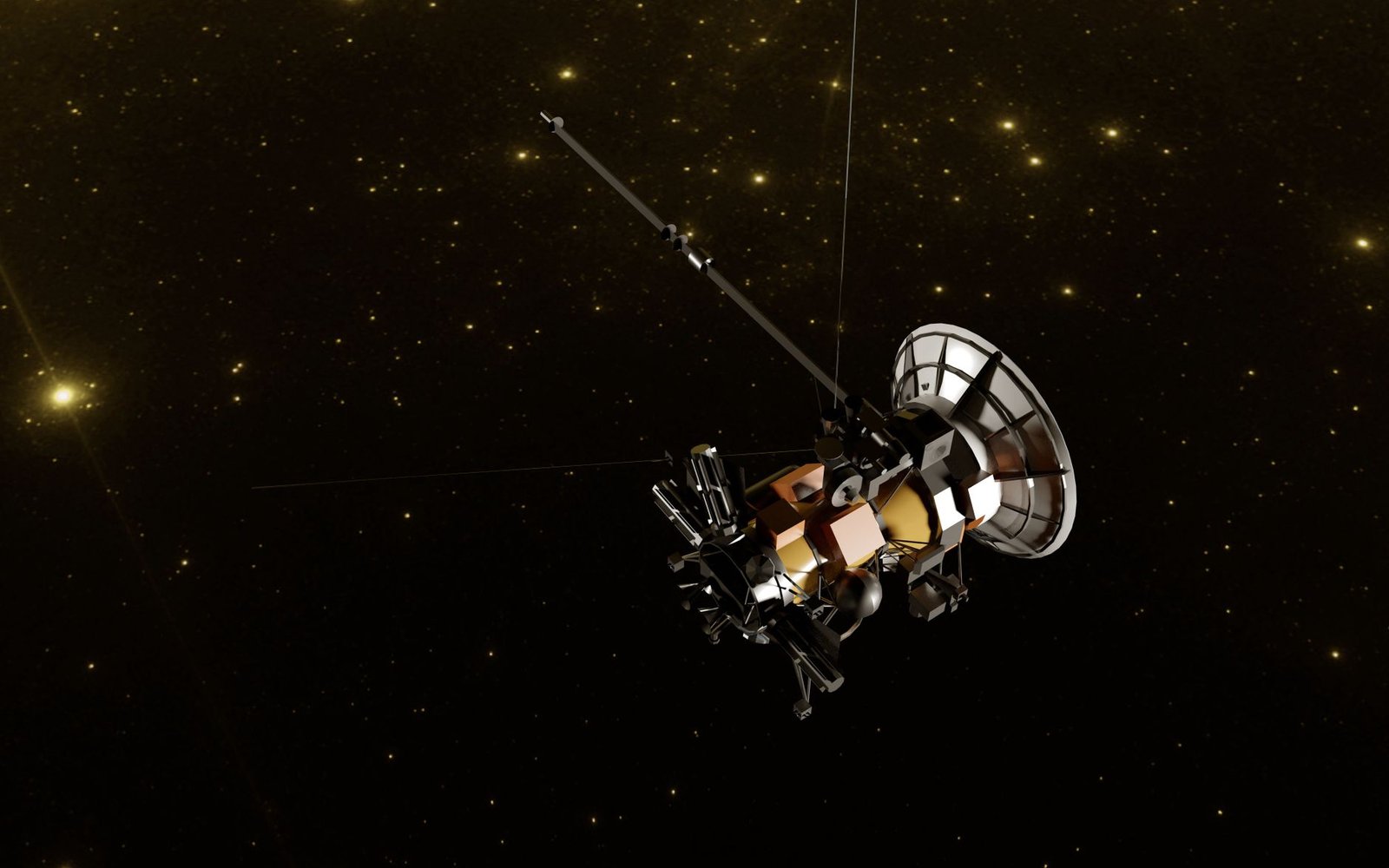
The Voyager 1 milestone is a remarkable achievement for NASA, showcasing human ingenuity in exploring the cosmos. This probe has now traveled light-days away from Earth, entering interstellar space and continuing to send data back home.
What is Voyager 1?
NASA’s Voyager 1 is a space probe that was launched on September 5, 1977, with the primary mission of exploring the outer planets of our solar system. Over the years, it has provided invaluable data about Jupiter, Saturn, and their moons, significantly enhancing our understanding of these distant worlds. Voyager 1 is renowned for being the first human-made object to enter interstellar space, a remarkable achievement that underscores the probe’s significance in the history of space exploration.
As of now, Voyager 1 is approximately 1 light-day away from Earth, marking another notable milestone in its journey through the cosmos. This distance highlights the probe’s extraordinary travel since its launch, as it continues to relay information back to Earth from beyond the influence of our sun. Its journey has taken it into an uncharted territory, providing scientists with a unique perspective on the heliosphere and the interstellar medium.
The Voyager 1 milestone illustrates not only the capabilities of human engineering and innovation but also the enduring quest for knowledge about our universe. As it travels further from home, Voyager 1 remains a testament to NASA’s commitment to exploration and discovery in the vast expanse of space.
The Journey of Voyager 1
The journey of Voyager 1 has been nothing short of extraordinary. Launched on September 5, 1977, this remarkable spacecraft was designed to explore the outer planets of our solar system. Over the decades, it has traveled farther than any human-made object, reaching an incredible distance of over 14 billion miles from Earth.
As Voyager 1 continues its journey through interstellar space, it recently achieved a significant milestone: it is now 1 light-day from Earth. This achievement highlights the probe’s remarkable capability to travel beyond the heliosphere, the bubble-like region of space dominated by the solar wind.
Throughout its mission, Voyager 1 has provided invaluable data, including:
- Stunning images of Jupiter and Saturn, revealing the beauty and complexity of these gas giants.
- Insights into the atmospheres, moons, and rings of the outer planets.
- Data about cosmic rays and the environment of interstellar space.
As it celebrates this latest milestone, the Voyager 1 mission stands as a testament to human ingenuity and the enduring spirit of exploration. With each passing day, it brings us closer to understanding the vastness of the universe, embodying the essence of what it means to push the boundaries of science and discovery.
Significance of the Milestone
The recent achievement of Voyager 1 marks a significant milestone in the exploration of interstellar space, showcasing NASA’s commitment to advancing our understanding of the universe. This pioneering spacecraft, which launched in 1977, has traveled farther than any other human-made object, and its latest milestone reinforces the incredible distances that can be covered through dedication and innovation.
As Voyager 1 reaches a point just over 1 light-day from Earth, it provides invaluable data about the region beyond our solar system. The significance of this milestone can be understood through various aspects:
- Scientific Knowledge: Voyager 1 continues to send back information about cosmic rays, magnetic fields, and the solar wind, enhancing our understanding of space beyond the influence of our Sun.
- Technological Advancements: The mission has driven advancements in technology, paving the way for future explorations and inspiring new generations of scientists and engineers.
- Interstellar Communication: Voyager 1 carries the Golden Record, a message to potential extraterrestrial life, symbolizing humanity’s quest for connection beyond our planet.
In essence, the Voyager 1 milestone not only celebrates a remarkable journey but also serves as a testament to human curiosity and resilience in the face of the vast unknown.
NASA’s Space Exploration Goals
The achievements of NASA’s Voyager 1 probe are a testament to humanity’s relentless pursuit of knowledge and exploration beyond our planet. As we celebrate the Voyager 1 milestone, it is essential to reflect on the broader goals that drive NASA’s space exploration initiatives. These goals extend far beyond mere scientific discovery; they encompass a quest to understand our place in the universe.
Navigating the unknown, NASA aims to:
- Expand Scientific Knowledge: Each mission provides invaluable data about the solar system and beyond, enhancing our understanding of planetary systems, cosmic phenomena, and the potential for life elsewhere.
- Inspire Future Generations: By pushing the boundaries of exploration, NASA hopes to ignite a passion for science, technology, engineering, and mathematics (STEM) among young people, fostering the next generation of explorers.
- Collaborate Internationally: Space exploration is a global endeavor. NASA frequently collaborates with international space agencies, sharing knowledge and resources to achieve common goals.
- Promote Technological Innovation: The challenges of deep space exploration drive technological advancements that often find applications back on Earth.
As Voyager 1 continues its journey, it serves as a symbol of these aspirations and the milestones that pave the way for future discoveries.
Future of Interstellar Travel
The Voyager 1 milestone is not just an impressive achievement; it also paves the way for future interstellar travel. As humanity’s first spacecraft to enter interstellar space, Voyager 1 provides invaluable data that can inform future missions beyond our solar system. The knowledge gained from its journey can help scientists understand the vast unknowns that lie ahead.
Future missions could take inspiration from Voyager 1’s design and technology, incorporating lessons learned to improve spacecraft longevity and communication capabilities. Several key areas are being explored:
- Propulsion Systems: Advanced propulsion technologies, such as solar sails or ion drives, could enable faster travel and greater distances.
- Habitation Modules: Future missions may consider designing spacecraft that can support human life for extended periods.
- Data Transmission: Enhanced communication systems could ensure that information is relayed back to Earth even from great distances.
As researchers build on the foundation laid by Voyager 1, the dream of reaching other star systems becomes more attainable. Each milestone achieved will inspire new generations of scientists and engineers to push the boundaries of human exploration.
How Voyager 1 Communicates
NASA’s Voyager 1, a remarkable probe that has traveled further than any human-made object, continues to push the boundaries of communication in space. As Voyager 1 reaches this significant milestone, it relies on a series of intricate systems to maintain contact with mission control on Earth.
One of the most impressive aspects of Voyager 1’s communication is its use of the Deep Space Network (DSN). This global network of large antennas is designed to receive faint signals from the spacecraft, which are often incredibly weak by the time they reach Earth. Currently, signals from Voyager 1 take approximately 22.5 hours to arrive, traveling at the speed of light.
The probe transmits data back to scientists, providing invaluable information about interstellar space. This data includes:
- The composition of cosmic rays
- The magnetic field strength in the region
- Temperature fluctuations
Despite the vast distance, Voyager 1’s communication systems are still effective. The probe uses a low-gain antenna for constant communication and a high-gain antenna for sending larger data packets. This capability ensures that NASA remains informed about the probe’s conditions as it continues its journey, marking a significant Voyager 1 milestone in humanity’s exploration of the cosmos.
Impact on Science and Technology
The recent Voyager 1 milestone marks a significant achievement not only for NASA but also for the field of space science and technology. Launched in 1977, Voyager 1 has provided invaluable data about our solar system and beyond, reshaping our understanding of the cosmos.
This milestone has profound implications for scientific research. As Voyager 1 continues to send back information from interstellar space, it enhances our knowledge of cosmic phenomena, such as:
- Interstellar Medium: The data helps scientists study the particles and magnetic fields beyond our solar system.
- Cosmic Rays: Understanding the behavior of high-energy particles is crucial for astrophysics.
- Heliosphere Dynamics: Insights into how our solar system interacts with the interstellar environment are gained.
Moreover, the technological advancements made during the Voyager missions have influenced numerous fields, including:
- Satellite Communication: Techniques developed for data transmission over vast distances have been adapted for modern communication technologies.
- Spacecraft Design: Innovations in engineering have paved the way for future explorations.
Overall, the Voyager 1 milestone signifies not just a momentous occasion for NASA, but also a pivotal advancement in the broader scientific community’s quest to explore and understand the universe.
Public Interest in Space Exploration
The recent Voyager 1 milestone has reignited public interest in space exploration, capturing the imagination of many around the globe. As Voyager 1 continues its journey through interstellar space, it serves as a reminder of humanity’s quest to explore the unknown. The probe, launched in 1977, has traveled further than any other human-made object, sparking excitement about what lies beyond our solar system.
Social media platforms and news outlets are abuzz with discussions and updates about Voyager 1, highlighting its achievements and the groundbreaking science it has provided. Many enthusiasts are sharing images and data collected by the probe, making space exploration more accessible to the general public.
In addition to inspiring awe, this milestone has prompted renewed conversations about the future of space missions. Schools and educational programs are utilizing the achievements of Voyager 1 to engage students in STEM (Science, Technology, Engineering, and Mathematics) subjects. The probe’s journey encourages young minds to dream big and consider careers in space science and engineering.
Moreover, documentaries and podcasts focusing on interstellar travel and the history of Voyager 1 have gained traction, illustrating the enduring human curiosity about the cosmos. As Voyager 1 reaches new milestones, it continues to unite people in their fascination with the universe.
The Voyager 1 milestone represents not just a remarkable technological feat, but also a testament to human curiosity and exploration. As we celebrate this Voyager 1 milestone, we reflect on the data and insights it has provided over the decades.
Photo by Paul Seling on Pexels